
//
News
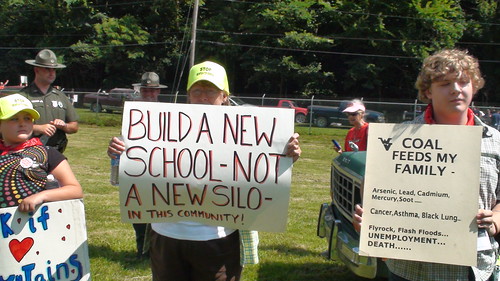
Last summer, a man spinning the wheels of a pick-up truck , shouting f--- you ! and shaking a one finger salute as a blue cloud of burned rubber hovered near Goldman Environmental Prize winner Judy Bonds and other protesters against mountain top removal mining showed a sad but not surprising irony : working-class people in this Appalachian community are in conflict with each other, while those at a safe distance from this drama have been getting rich by damaging other people's air, land, and water.
Bonds and other activists know this, but their efforts to find common ground with the miners has become very difficult as this controversy has led to tensions in this generally poor rural community. Even though Bonds has been threatened with violence on many occasions, she recognizes the workers engaged in strip mining are also being exploited.
"We will stand by the workers if they will challenge the politicians and demand they bring in new jobs to the area. Only the politicians have the power and clout to bring in new industries, not us poor citizens," said Bonds, who was assaulted by a counter-demonstrator during a protest last June.
That protest drew international attention when NASA scientist James Hansen and Hollywood actress Daryl Hannah were among the dozens of people state police arrested during the non-violent civil disobedience at the Goals Coal Processing Plant, operated by Massey Energy.
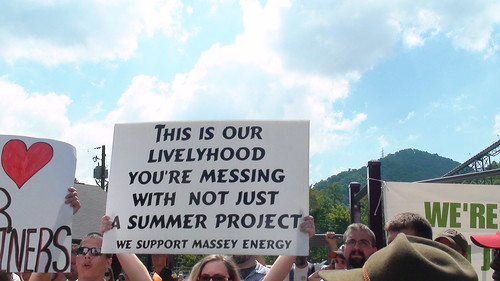
Massey employees were at there as counter-demonstrators, along with their friends and families. Some of them held spray-painted bed sheets while others held plastic placards with messages written in magic marker ink.
The Massey employees and other counter-demonstrators blared car and truck horns, revved motorcycles, and shouted vulgar insults in an attempt to drown out the electrically amplified speeches of a long list of well-known and not-so- well-known activists.
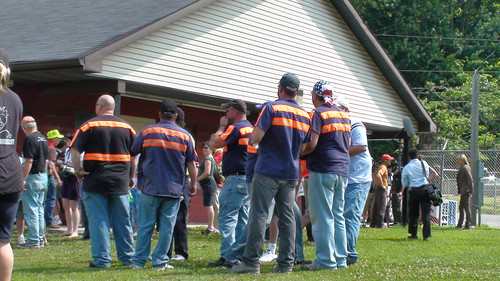
At one point, the power to the amplifiers was lost as counter demonstrators howled, whistled, and blew air horns. When the power was restored they taunted the activists saying, "Where's that power come from ? Thought you didn't like coal...Did drive to get here...?"
Later that day, many of them jeered and howled deliriously as the police-- making their arrests---grabbed protesters by the crooks of their arms after they had sat down in front of the entrance to the Massey coal processing plant in an act of civil disobedience.
That day in June at times had at times the surreal ambiance of a festival or perhaps half-time at a football game played by intense rivals where fans for opposing sides milled about awkwardly . The arrests later that day seemed to be the grand finale, at least for the counter-demonstrators and some of the members of the media army.
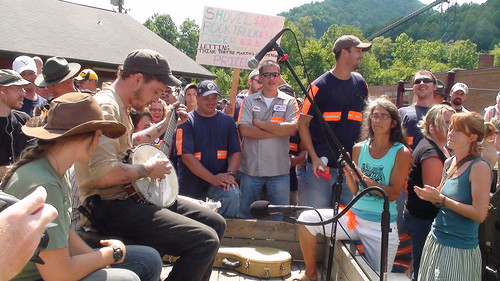
At one point, banjo music and singing eased tensions if only for a while. This scene was a stark contrast for what would come later in the day. As the counter-demonstrators talked among themselves, they did not seem to mention out-of-state coal companies making a lot of money from blowing up the mountains with the help of politicians.
Instead they grumbled or shouted about out-of-state environmentalists, out-of-touch with West Virginia's economic issues, descending from their big city ivory towers to cause trouble in this small rural community.
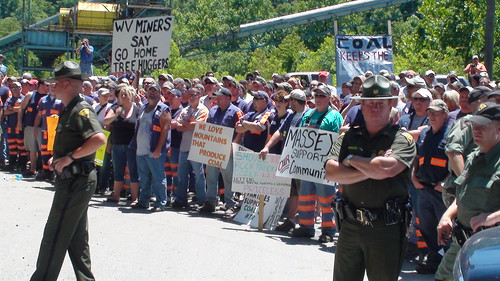
One man wearing dark blue coveralls with orange strips attached said misguided locals have too much time on their hands. "They need to get a life. They need to get a job. Ask yourself how many of them are gainfully employed. I bet 90 percent of them have no idea about what they're protesting against."
Bonds said activists against mountain top removal mining are not stepping into the trap of being divided and conquered. On countless occasions they have openly stated they are not against the surface miners, but instead are against the destructive practices of the industry.
"We've taken the high road. The violence is not coming from our side," said Bonds. "The (coal) industry is happy to pit workers against people that just want to live in safe communities. Jay Gould, the hated robber-baron said in 1898, 'I can hire one half of the working class to kill the other half.'"
In the 1980s, the late Judi Bari, a principal organizer of Earth First! led efforts to unite timber workers with those fighting to stop logging in the ancient redwood forests of Northern California. But Bonds is skeptical about activists and surface miners finding unity through shared class consciousness.
"The coal industry has 140 years of oppression here. We try as much as we can and some volunteers have tried as well, but the oppressed coal miners aren't having any of it. The threats and violence are getting worse and the strip miners are only listening to the coal companies now. Logging in California and coal mining in Appalachia are two different animals," Bonds said.
She said she worked with Bari and respects her achievements, but that the alliance between loggers in California and environmental activists ultimately failed.
However, she said Massey's anti-union policies and its poor record on worker health and safety, could somehow connect to what the company is doing to Appalachia's air, land, and water.
But it remains to be seen whether environmental activists fighting to stop maintain top removal mining will find common ground with whatever anemic remnants of the labor movement remain in these poor rural communities where people have far fewer job options than city and suburban dwellers.
Something analogous to the Blue-Green Alliance between the Sierra Club and United Steel Workers doesn't look promising. Cecil E. Roberts, president of United Mine Workers of America, has essentially come out in support of mountain top removal.
Bonds said she will not dismiss off-hand such an alliance, though she said it is unlikely to happen anytime soon. "Like Upton Sinclair said, 'It is difficult to get a man to understand something, when his salary depends upon his not understanding it.'"
Bonds also said, "It's something similar to battered wives' syndrome. It's easier to fight other powerless citizens and 'tree-huggers' than to fight big business. Coal owns 95 percent of this state. It's like a banana republic."
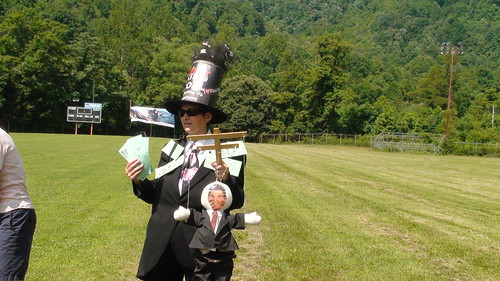
During the protest last summer, activist Vivian Stockman drew stares and dismissive smirks from some of the Massey counter-demonstrators. Wearing a top-hat that resembled a coal-plant smoke-stack, and a top-coat with over-sized fake money pinned to the lapels, she was a robber baron from whose hands dangled a string puppet of West Virginia Governor Joe Manchin.
The difficulties with creating common ground between activists and Massey workers notwithstanding, Bonds said having a unified movement that combines economic issues with environmental issues could loosen the coal industry's grip on Appalachia. But she is aware of the challenges.
"We are trying to put pressure on politicians, but we don't have the energy, the numbers or the money to fight all the battles. So we focus on what we can fight. The big groups might be able to do that, but we (Coal River Mountain Watch) are a small organization that does not have those resources," Bonds said.
Bonds said she has heard, countless times, people defend mountain top removal mining for economic reasons. She rejects the idea that people have to choose between having jobs and taking care of Appalachia's air, land, and water.
"When talk about the miners' jobs comes up, we need to say that a good environment leads to a good economy. There are no jobs on a dead planet," Bonds said.
Bonds said common people who are standing up for their human rights by opposing the mining practices that are harming the communities they live in, should not have the added responsibility of creating less destructive jobs for the people the industry employs.
"Environmentalists and citizens like myself don't have the power or the energy to work on both saving our air and our water and then, on top of that, bringing in new jobs. The workers (for Massey Energy) should put the blame on the corrupt politicians and the industry that's doing the poisoning. They shouldn't blame people that don't want to be poisoned. It's not our responsibility to provide jobs in exchange for not being poisoned and terrorized."
Bonds said ending mountain top removal mining would create jobs. "With the federal Abandoned Mine Lands money, the strip miners will have many years of work trying to fix the destruction that has already taken place. There's no need to even get off the bulldozer. Just turn it around," Bonds said.