
//
Opinion
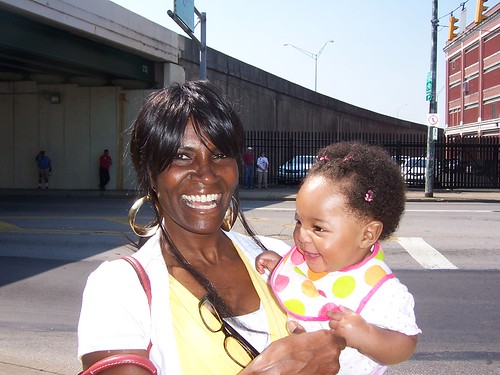
Kimberly Jackson Morris & Jamira Jamison stood along Cleveland Avenue as President Obama spoke at the Fort Hayes High School about his jobs plan on Sept 13. Not far way were about 20 protestors holding signs and chanting "Barack Obama, yes you can. Say no to the tar sands."
The Keystone XL pipeline would carry tar sands oil from Canada to Texas where it would be refined and shipped to other countries. There were no people of color in the protest, though a Black elder sat nearby on a lawn chair so as to stay in the shade during the hot September day.
Morris said the under-representation of people of color in the environmental movement is a case in point on the importance of education.
"We're not educated on those facts...When you go into lower economic areas, there's no one standing there giving us information about a pipeline."
Morris said white middle class environmental activists should spend time in Black and low-income parts of town.
"Go into those communities and talk to people. There are people who aren't too busy to listen. But the information isn't there. Do you go into these communities and speak w/ people about these things that you're protesting ? I'm talking about urban communities."
Morris said standing in the street holding signs won't necessarily engage people who aren't currently involved with environmental and other causes.
" It's not personable enough. When you address me---me individually, or my community, then I see that you care. I don't want someone standing on a corner yelling some important information that I'm not going to listen to. If I'm on my way to work, or if I'm on my way to pick up a child, no, I'm not going to stop and listen to you. But if you're in my community and I happen to be walking to the community grocer, then yes, you're giving me some information and I'll stop and speak w/ you."
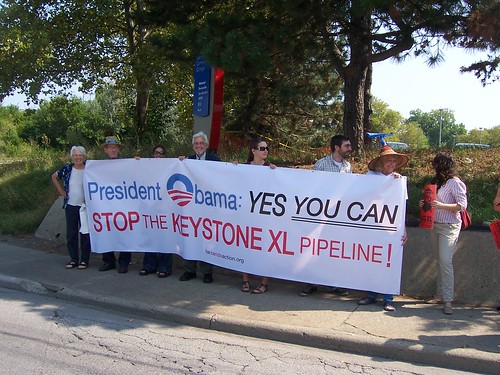 She said activists such as those fighting Keystone XL need to listen to and learn from people in the communities we go into, instead of assuming we're there only to talk and teach what we know.
Morris suggested the Eastside near downtown as a specific place for engaging w/ Black and low-income communities.
"When you get close to Columbus State and Fort Hayes-- really lower economic areas-- people don't mind listening. If they know you're there for a reason, they'll stop and talk w/you---if you're there."
Morris agreed urban farming and community gardening are ways to form bridges between the mostly white and middle class environmental movement and people living in historically under-served communities.
"My daughters and I are building a garden. We believe in organic food...I don't like chemical pesticides and fertilizers. But if you go into the poor areas, this is all we're eating. Everything is loaded w/ chemicals. Everything is processed. We don't have the information though to know any better. Until we get the information to know any better, how can we do any better ? "
She said churches are an important venue for forming new ties among activists and community organizers.
"Churches are number 1 in Black communities. You get on board w/ the ministers and pastors and they'll help you. You have to inform them as well. But they will get the word out to their church members."
On that same day, I had a similar conversation with Rev. Kujenga Eliyah Ashe.
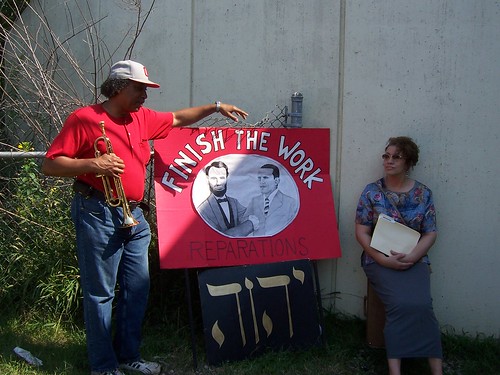 Ashe with his wife K. Lanai Ashe near the Fort Hayes High School where President Obama spoke during his visit to Columbus to highlight his jobs plan.
Ashe is the executive director of Community Organization for Abundant Life COAL I asked him what he thought of the environmental movement.
"The Earth is being raped by multinational corporations. They're polluting the Earth. Instead of using the solar power and wind power that they could be using...they're using fossil fuels. They're doing that because there's so much profit in it."
Ashe said he and fellow activists are pushing for an economic rights movement.
"The civil rights movement which Dr. King led has done great things. We even have a president w/ brown skin. So his dream has come true in terms of civil rights. But Dr. King, before he was killed, was starting to push for economics. He was boycotting different corporations and was planning a poor people's march on Washington, just like up in Chicago. They still have the Poor People's Campaign headed by Jerry Robinson."
Ashe said an economic rights movement lends itself to being broadly inclusive.
"The Civil Rights Movement helped all people-- black, white, red, yellow, gays, women. Everybody piggybacked on the Civil Rights Movement. Now we have our civil rights. We can vote. We have the franchise and (Black) mayors, congresspeople, senators, and even the president of the United States...Now we need our economic rights."
Ashe said the first program of that economic rights movement is repatriation and reparations for all descendants of slavery.
"We want gold, silver, and land, not just from the federal government but also from the monopoly finance, capitalist, multinational corporations--the Wall Street Investment bankers. We want to have a march on Wall Street, July 4, 2012, to tie it up and to demand reparations for all the people. New York was built and Wall Street was built on the labor of slaves. They used to sell slaves on Wall Street. "
He said building a mass movement requires spirituality.
"We need something that will inspire people, that will get their hearts, not just their minds. We can't just get them to read the ABC of Communism by (Nikolai) Bukharin (and Yevgeni Preobrazhensky)...We got to reach people at their hearts, not (just) their heads. The Civil Rights Movement got people at their hearts. Dr. King got people at their hearts. All people, black, yellow, brown, and Native American came together. That's what we need now."
Unlike Kimberly Jackson Morris who suggested White middle class activists within the environmental movement reach out to churches in Black communities, Ashe--himself a minister--- said that's not the place to start.
"The churches are not really going to move until they see the progressive organizations moving. The churches are always the last ones on board. They're pretty much the gatekeepers of society. When Dr. Martin Luther King Jr. came to Columbus, Ohio back in 1964, he only preached at one church, Union Grove Baptist. All of the other churches wouldn't let him preach because he was talking about a movement and they were saying, 'oh, well, we're doing alright like it is.' So I wouldn't suggest anybody run to the churches right now. Go to the progressive organizations (within Black communities). Find the progressive people. We're on Facebook and we have websites."
In addition to that Ashe said:
" You got to then push the issues that help people of color...The welfare programs have been cut out by Governor Kasich here, by Governor Snyder in Michigan and Governor Walker in Wisconsin. You got to go to them (Black folk) and say 'we understand your issues, and your issues tie with our issues.' You got to go to the progressive organizations."
tomover@thecolumbusactivist.org