
//
Opinion
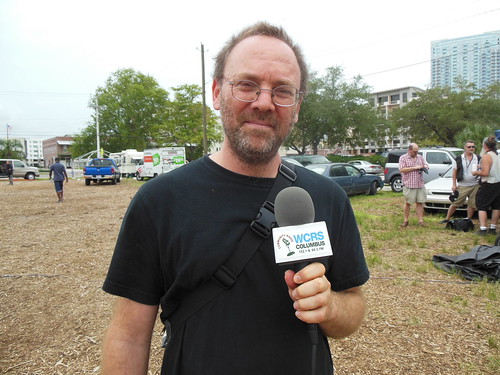 Singer, songwriter, and activist David Rovics talked with us on Aug 28 in Tampa Florida at Rommneyville , an encampment set up by the Poor People’s Economic Human Rights Campaign as part of events to counter the Republican National Convention.
“Love is an integral component of any social movement. Activists usually act out of some combination of self-preservation and concern for the self-preservation of a larger group, like humanity or the working class.”
He said people don’t get involved in activism unless they have a deep concern for their fellow humans.
“Many different people have said this thru out history. And this is true of people whether they are involved in violent or nonviolent struggle.”
When I suggested social movements involve the question of love vs. hatred or love vs. indifference instead of them involving nonviolence vs. violence, Rovics said, “I don’t agree with the concept of diversity of tactics. That’s just another way of saying we can’t agree on our tactics, so we’re agreeing to disagree. I think it’s very clear what kind of tactics are counterproductive in certain situations.”
He said the only tactics that are effective are the ones that can have mass popular support.
“As soon as you engage in a tactic that cannot be understood or supported by most people, you have screwed the movement and yourself.”
He said what’s effective varies depending on what country or what city you’re in.
“Tactics that won’t appeal to most people in the US do appeal to people in other countries or they appeal to people in the US in a different situation. But, generally, when it comes to protesting conventions and other such things, it’s not the time or place for rioting or trashing.”
Rovics said another way of understanding why these tactics are counterproductive is the fact, not the supposition, that police infiltrators participate in black bloc tactics.
“Police put on masks and smash windows and then go back and join the ranks of the other cops. This has been documented with video evidence in the US and other countries.”
I told Rovics anarchism seems one of the most widely misunderstood concepts.
“Of course, with anything such as anarchism, socialism, communism, democracy, liberty, freedom---these are all very general terms and they are defined differently by a lot of different people…But if we’re talking about the anarchist republic that existed for several years in Spain in the 1930s, then anarchism certainly does not mean disorganization or widespread violence.”
He said, like with other ideas, anarchism is misunderstood both by those who agree with it and those who don’t.
“There are untold numbers of people on the Left who in their own mind are anarchists and might be called anarchists by other people, but they don’t necessarily go around saying ‘I’m an anarchist’ or wear black or cover their faces.”
He said he doesn’t disapprove of young people who wear masks and dress in black, but said they don‘t represent all anarchists.
“In the WTO protests in Seattle, we had 200 people smashing stores in Niketown and 2,000 people getting tear gassed for committing nonviolent civil disobedience and shutting down the WTO meetings. Most of the 60,000 people or at least a large minority of them considered themselves to be anarchists, but in the eyes of the media, ‘the anarchists’ were the ones smashing things, and all the rest of the 60,000 were not. That’s nonsense.”
Rovics said only a tiny minority of the people who were at that protest actually believed in the tactic of deliberately causing property damage.
“But those are the ones who self-identify as anarchists and get identified by the media as anarchists.”
I asked Rovics what he thought of the idea indifference is worse than hatred.
“I don’t know how much hatred really works as a motivation. But anyone who has love for humanity and love for the planet also has hatred for politicians and corporations that are destroying humanity and destroying the planet. But if hatred is your primary motivation, you’re not going to get anywhere.”
Rovics said indifference is our biggest problem as a species.
“It’s what characterizes the behavior of most humans when it comes to trying to change things on a broad scale. There is a lot of empathy and love that is exhibited by humans everyday for their families and communities and, in more socially activated societies, for society as a whole. But in this society, indifference and apathy are huge problems. But as soon as a large number of people get together, the possibility for changing things becomes real.”
But this happens only when people overcome indifference and apathy, Rovic said.
“That’s, by the way, a magical formula which everybody on the Left is trying to figure out. Nobody has, otherwise it would happen a lot more often.”
I asked Rovics if he considers himself someone who thinks beyond a left-vs.-right framework.
“It depends on how someone defines left and right. I always have a problem with definitions, but I tend to call myself, when pressed, a libertarian socialist, just because it confuses people and they have to think about what that means. I would say there are a lot of people who call themselves Republicans, Libertarians, or right-wingers who actually I have a hell of a lot in common with as do most people who would consider themselves on the Left.
“The biggest differences are among subcultures. But in terms of political perspective, you got all those Republicans voting for Ron Paul who are against American imperialism. That alone gives us a heck of a lot of common ground. We have a lot of common ground with them on civil liberties too. But we have a lot of differences with them when it comes to whether there is a social contract where people have a guarantee of food, housing, and medical care. I have major differences with them on that. But I have a lot more in common with them than I do with some Socialist or Communist parties that don’t believe in real democratic decision-making.”
Rovics said he doesn’t agree with democratic centralism.
“I understand why some people do. I think it has its uses in wartime situations and in the context of a guerilla struggle perhaps, but in times like these, I think it’s totally counterproductive and exclusive. Groups need to be ecumenical and inclusive and democratic, not vanguardist.”
A few weeks ago I wrote a response to Nathan Schneider’s article No Revolution Without Religion, saying what’s needed is a type of spirituality based on love that includes, but is not necessarily based on religion. I asked Rovics what he thought about that.
“ I don’t believe in any mythical beings that there’s not any evidence for the existence of. So, I believe in science and I’m an atheist. But for people on the Left to sort of get religion--unless they really believe in these things---would be silly.”
He said it’s important people on the Left have a deep respect for those who do have religious faith, as a matter of being inclusive. He said things can get cliquish among some parts of the Left, leading to people feeling excluded when they aren’t already involved with various political groups and don’t know the political terminology.
“Deriding people who have religious faith is part of the problem, but at the same time there is a strong tradition of the Left among different faith communities.”
He said there is a strong left wing tendency among some Catholics and other Christians.
“Liberation Theology is one example. Whatever gets people to that position is great. But in terms of having a spiritual perspective and doing things together as a community rather than just protesting but also singing and doing church-like things, this is extremely important. We definitely need lots more of that, which is why I’m a musician.”
I asked him if building community in this way involves love.
“Love is what it’s all about. Having a community that cares about each other and the world is all about love. When you do things together, like people are here doing in Romneyville-- you camp together, you eat together, you play music together, you protest together. This is all part of the collective human experience which tends to make people feel even more love and more community.”
I asked Rovics about the idea of loving our enemies. He said he believes in that.
“But that doesn’t mean we allow them to destroy the world and kill people, bomb people, and etc. We have to stop that. Certainly, we have to stop that by any means that will be effective.” He said there is contention about what methods are the most effective.
I suggested to Rovics we don’t have to hate our enemies to harm or kill them if there is no other way to defend ourselves or to help those being oppressed or wrongfully attacked.
“The most common and incredibly sad example is --it’s a fairly extreme example, but say you’re somewhere like El Salvador or Iraq, for that matter, and in the midst of a guerilla war trying to overthrow a dictatorship. The people you’re going to end up fighting and killing in the process of this struggle unfortunately are overwhelmingly going to be people who are not in any decision making position--people who did not organize this war or occupation. You’re going to be fighting and killing poor and working class and not very well educated young guys who are basically economic draftees and draftees in the more conventional sense, depending on the situation, and who have no idea what they’re fighting for. They’re going to be the ones paying the price for the crimes of their masters.
“That’s the reality. But, of course, if you’re country is being occupied, and it’s possible to organize a movement to kick out the occupier and that resistance movement for whatever reason in a different situation needs to be an armed one, then that’s unfortunately what’s going to happen: the working class killing each other.”
Rovics said that’s unfortunately how it goes with both conventional and guerilla wars.
“But up until the time you end up shooting somebody, you have to hope there’s the possibility they’re going to recognize the error of their ways and that they shouldn’t be defending an empire or, in the case of El Salvador, the 20 families that own that country, which was what the Salvadoran military was defending during that civil war.
He said soldiers at any point can and have deserted from the army and joined the other side or just stopped fighting.
“That’s what you want. You don’t want to have to kill people. But of course this is theoretical for us because it’s not applicable to our situation in the United States.”
I asked Rovics how this applies to relationships between cops and protesters.
“It’s really important not to be antagonistic toward the cops, and to realize they are underpaid working class people who have a very dangerous job and who are very brainwashed, particularly the White ones. I’ve noticed cops who aren’t White tend to be a lot less brainwashed. I’ve noticed this from conversing with a lot of them as I like to do...They’re people too. I personally know really wonderful cops in this country who are progressive, thoughtful people. I think they’re a small minority of the police force, but they do exist.”
He said there could be more cops like that if the Left did a better job of communicating.
“It’s an uphill struggle obviously, but it certainly can be done. People should remember what happened in Tunisia and Egypt. That can happen anywhere in the world. It has happened in places including this country. There’s a lot of history of the police and the military abandoning their posts and joining the other side, whether the other side was the Mexicans in the Mexican-American War or the Farmers Rebellion in western Massachusetts.”
Rovics said there are many examples of this and there will be many more.
“But if we can stop antagonizing the cops and recognize their humanity, that would be a big step forward, though it’s understandable why people have trouble with that, because it’s hard to love somebody who beats you with no provocation in most cases, unless provocation is chants, yells, or whatever, which is supposed to be free speech.”