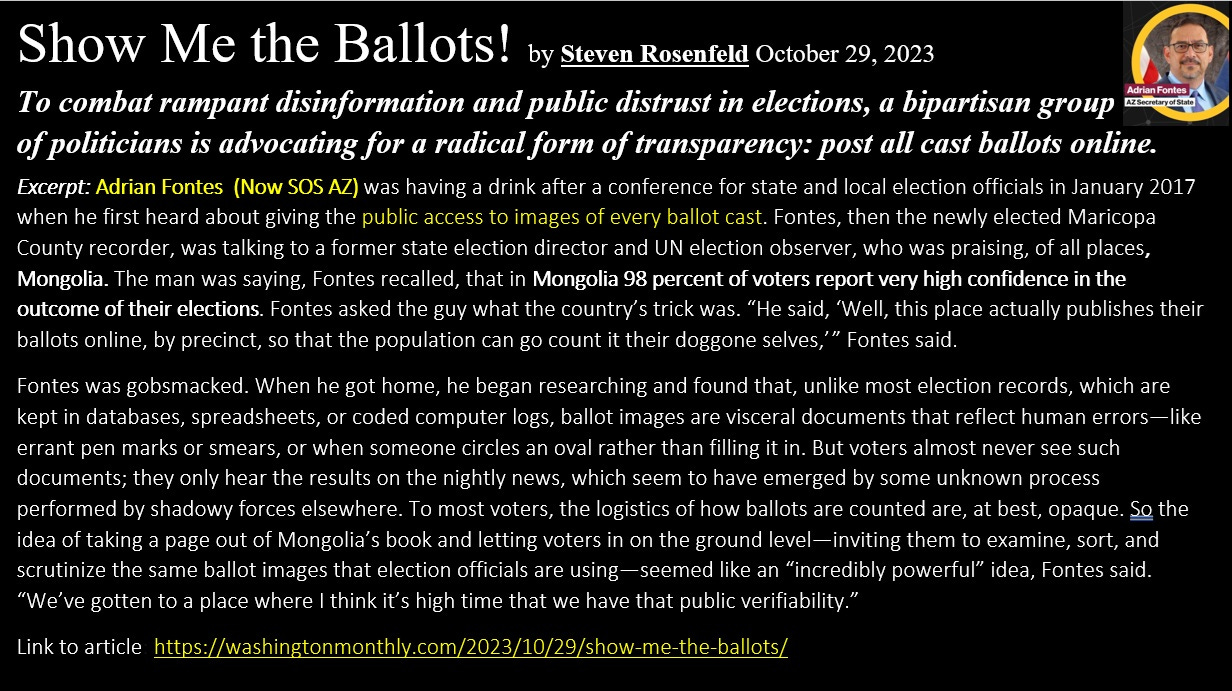
Something extraordinary — and deeply concerning — is happening beneath the surface of American election administration.
Under the proposed MOUs, states would be required to turn over
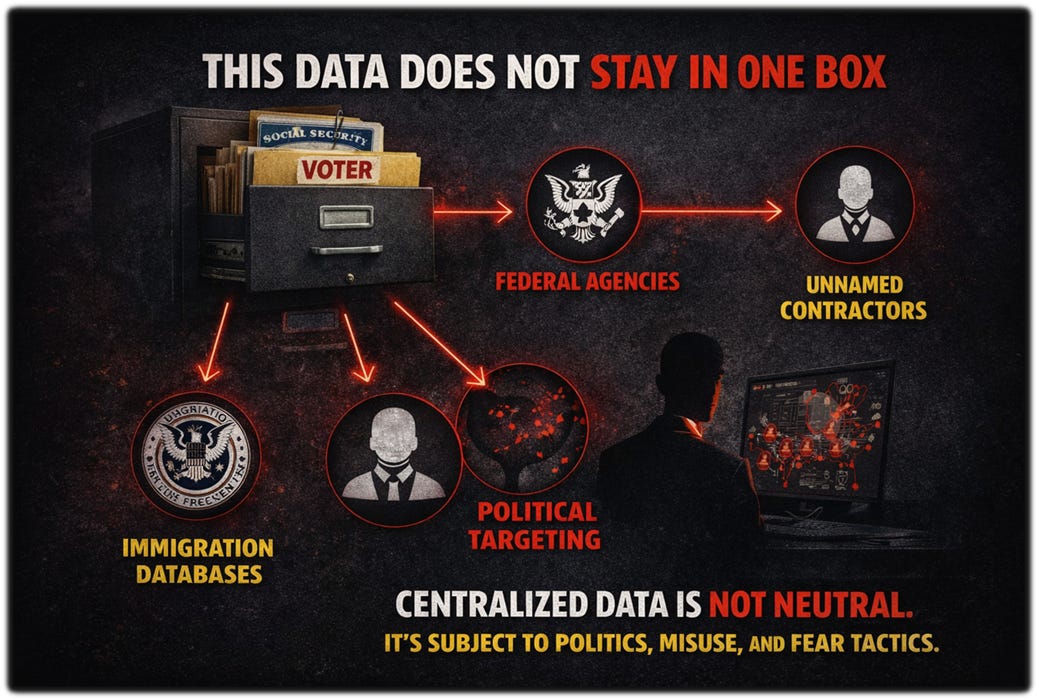
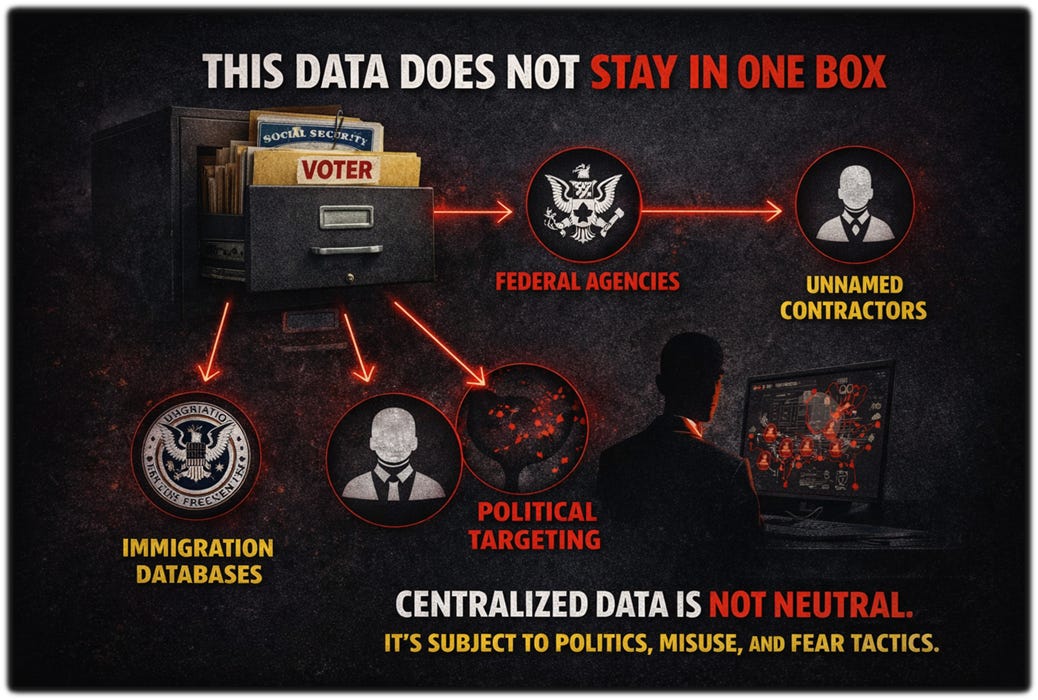
unredacted voter data — including dates of birth, driver’s license numbers, and partial Social Security numbers — to the federal government for review, analysis, and so-called “verification.” Federal officials — and unnamed contractors — would then flag voters as allegedly ineligible. States would be expected to remove those voters within 45 days, then resubmit their voter lists to DOJ for approval.
This is not a technical adjustment.
It is a structural shift of power.
A Break from Two Centuries of American Practice
For more than 200 years, the United States has deliberately maintained a decentralized election system. The Constitution assigns election administration primarily to the states, with the federal government acting as a limited backstop — intervening to protect civil rights, not to manage voter lists.
What the DOJ is now proposing represents a sharp departure from that tradition.
Two states — Colorado and Wisconsin — have already rejected the agreements outright, citing state law, voter privacy, and constitutional limits. Meanwhile, the DOJ has sued more than 20 states for refusing to turn over unredacted voter data.
Federal officials have also openly acknowledged interest in what critics warn could become a national voter database.
That should give everyone pause — regardless of party.
The Problem Isn’t “Clean Voter Rolls.”
It’s Centralized Power.
This effort is being justified in the name of preventing non-citizen voting.
But facts matter.
Verified cases of non-citizen voting are exceedingly rare. States already conduct voter list maintenance using death records, address changes, jury disqualifications, and long-standing legal safeguards. This work has traditionally been done locally, transparently, and with accountability.
What is new is centralized authority.
Centralizing sensitive voter data creates risks that go far beyond election integrity:
Increased likelihood of data breaches or misuse
Error-prone database matching that disproportionately impacts
naturalized citizens, seniors, and voters of color
Voter removals driven by opaque federal criteria
Chilling effects on voter registration and participation
A precedent that future administrations — of either party — could expand or abuse
Even if current intentions are sincere, systems matter more than motives.
Once authority is shifted upward, it rarely returns without resistance.
A Transparency Crisis Hiding in Plain Sight
This is also a transparency problem.
1. The agreements are confidential
2. The contractors are unnamed
3. The standards for flagging voters are vague
4. Due process protections are unclear
5. Voter notification is uncertain
That is not how public trust is built.
At a time when confidence in elections is already fragile, the answer is not to ask Americans to trust secret federal processes.
The answer is to make elections verifiable, auditable, and observable by the public — without compromising voter privacy or constitutional balance.
That is exactly the work we are doing at AUDIT Elections USA, alongside former Arizona Secretary of State Ken Bennett, through a simple but powerful tool called Auditable Ballot Examination (ABE).
What ABE Does — and What DOJ’s Plan Does Not
ABE does not centralize power.
It distributes verification made simple.
ABE allows citizens, journalists, and election officials to independently verify election results using existing public records — without exposing personal voter data and without handing control to any federal authority.
This story is the opposite of ABE:
DOJ seeks centralized authority
ABE creates distributed verification
DOJ asks citizens to trust federal processes
ABE lets citizens check the math themselves
DOJ operates through confidential agreements
ABE operates in public sunlight
The Principle at Stake
A democratic republic depends on two principles holding at the same time:
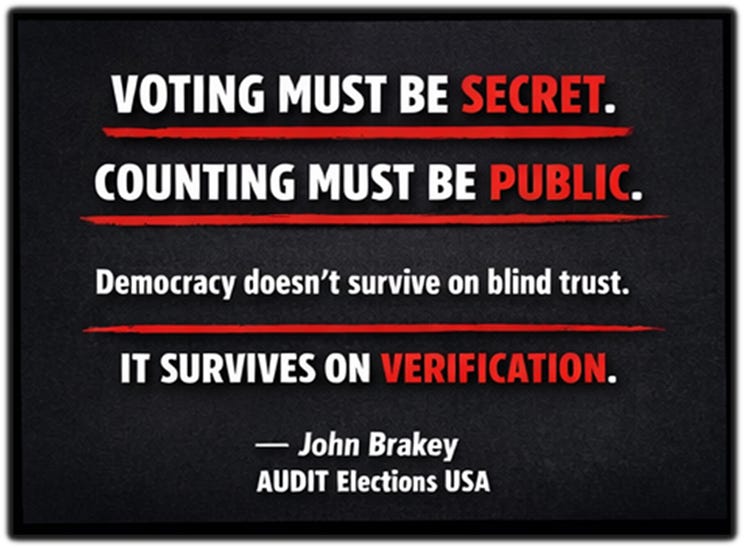
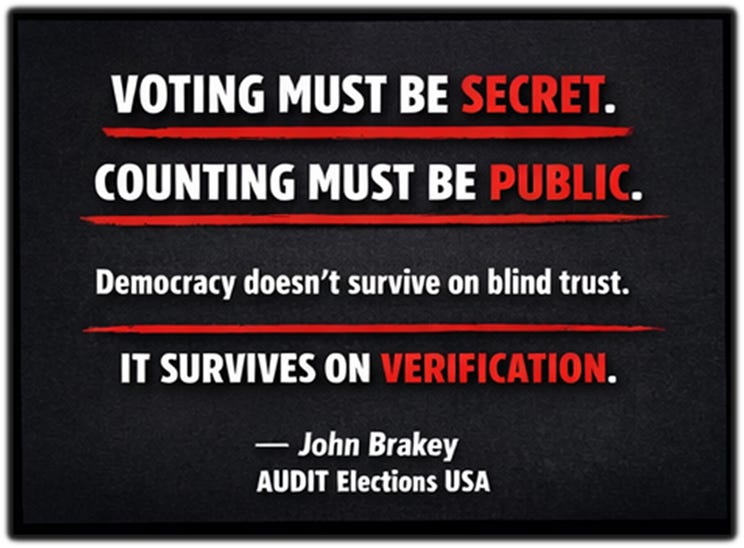
Voting must be secret
Counting must be public
When governments consolidate control over voter data while reducing transparency, the danger is not hypothetical.
History shows that democratic erosion often arrives quietly — wrapped in the language of security and efficiency.
This moment does not require panic.
It requires vigilance.
Because once the election administration moves out of the sunlight and into confidential agreements, the burden shifts from citizens verifying their government to citizens being asked to trust it blindly.
And that is not the American tradition.
What Comes Next:
Part 2 of 2: Technofeudalism, Voter Data Power, and the New Architecture of Control by the Feds
This article focuses on what the DOJ is doing.
The next article will focus on who is driving this philosophy of centralized power — and why.
It will examine:
Technofeudalism
Data control as political power
Peter Thiel’s worldview
JD Vance’s role
And why elections are only the beginning
1-PAGE EXECUTIVE SUMMARY (SHAREABLE)
The Federalization of Voter Rolls — A Quiet Power Shift Americans Should Understand
What’s Happening
The U.S. Department of Justice has circulated confidential agreements (MOUs) to multiple states that would require them to hand over unredacted voter data to federal officials and contractors for review.
Why It Matters
This shifts election authority away from states and local officials and toward federal executive control — without legislation, transparency, or public debate.
Key Risks
Centralized voter databases
Error-prone voter removals
Disproportionate impact on citizens of color and naturalized voters
Reduced transparency and due process
Dangerous precedent for future administrations
What’s the Alternative?
Auditable Ballot Examination (ABE) allows public verification of election outcomes without exposing voter data and without centralizing power.
Bottom Line
Election integrity depends on transparency, not secrecy.
Verification, not blind trust.
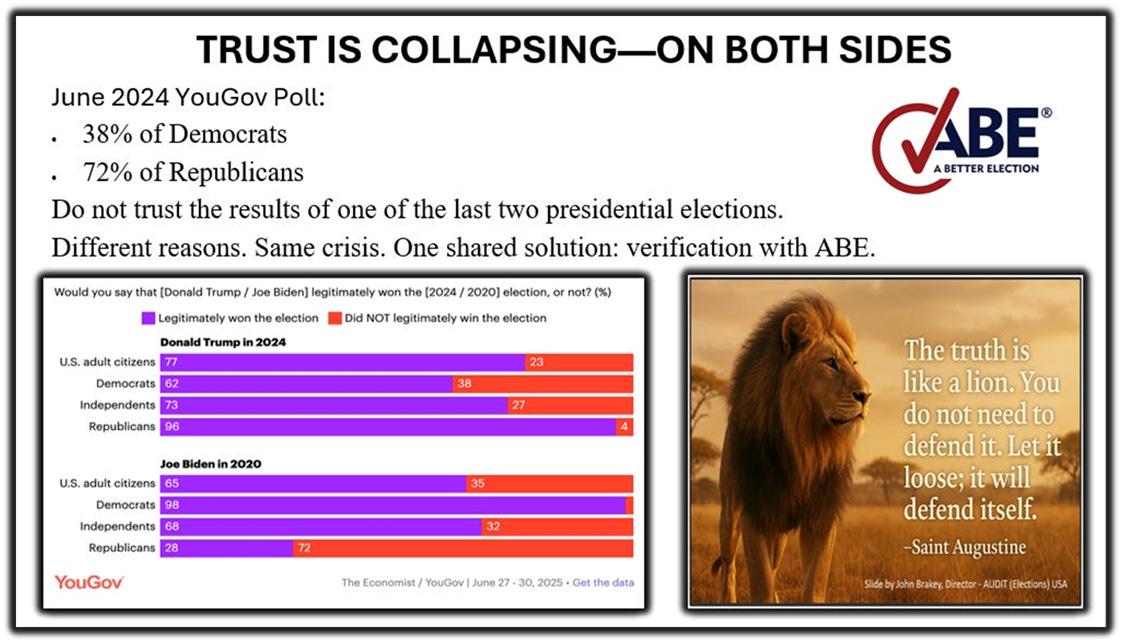
The Trust Crisis No One Can Ignore
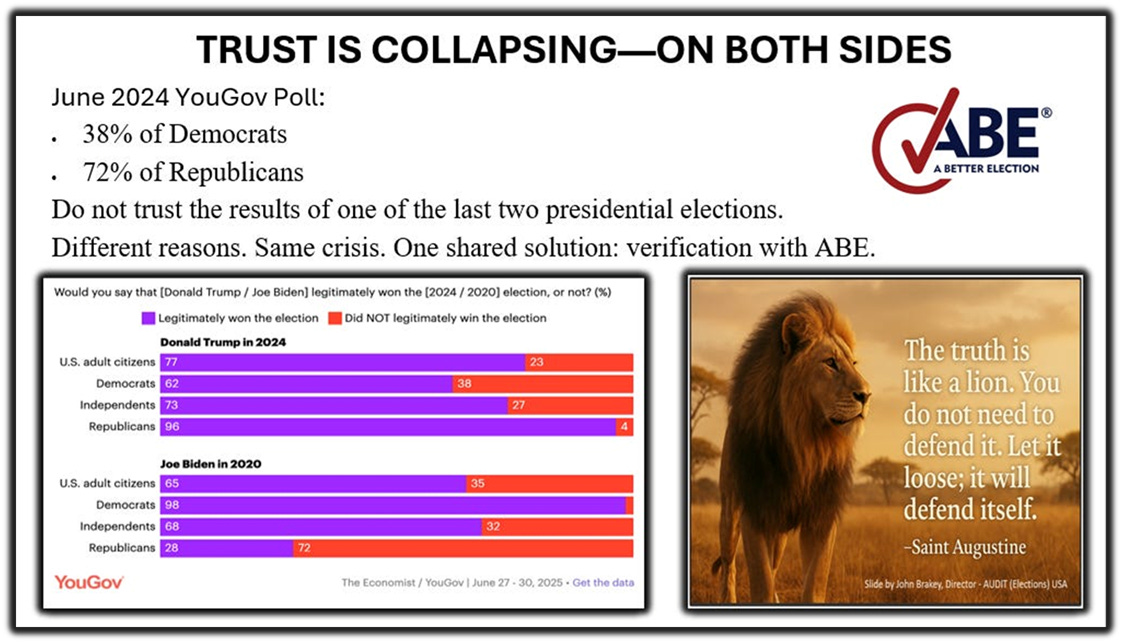
In recent polling:
• Nearly 4 in 10 Democrats, and
• More than 7 in 10 Republicans say they do not trust the result of at least one of the last two presidential elections.
That is not a fringe problem. That is a regime confidence problem in a nation that calls itself a democratic republic.
We’ve all heard the lines:
“My vote doesn’t matter.”
“It’s a rigged game.”
“If voting really made a difference, they wouldn’t let us do it.”
“Both sides are corrupt.”
When that attitude settles in, democracy doesn’t just feel shaky—it becomes unstable.
At AUDIT Elections USA, we operate from a simple principle that guided the entire Cochise meeting:
Voting must be secret. Counting must be public.
Trust comes from verification—not faith.
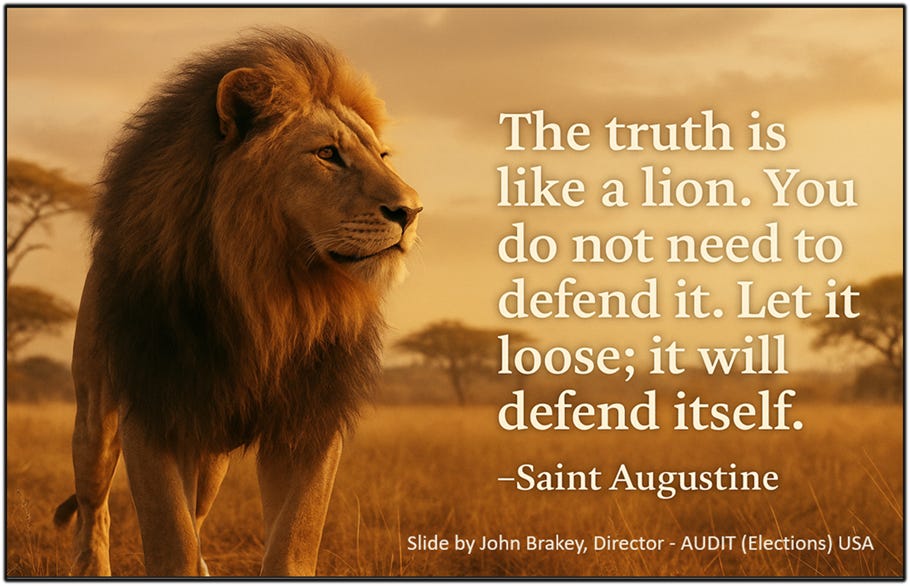
Ken Bennett brought up a quote attributed to St. Augustine:
“The truth is like a lion. You don’t have to defend it.
You just let it loose and it will defend itself.”
John R. Brakey
Executive Director, AUDIT Elections USA
Co-Developer of the ABE Hybrid Verification System
Election Transparency Investigator, Educator & Reform Advocate
📞 520-339-2696
📧 JohnBrakey@gmail.com
“Trust but verify.” — Ronald Reagan
“Without verification, trust cannot be established.” — Bennett & Brakey

AUDIT USA is a 501(c)(3) organization. Your donations are tax-deductible!
Send donation check to:
AUDIT USA P.O. Box 26361
Tucson, AZ85726
Or Donate online using this
We appreciate donations of any size.

Conclusion
The document concludes that election integrity depends on transparency, public oversight, and verifiable audits. ABE offers a practical tool to restore these principles by linking ballot images to CVRs for accessible, citizen-led verification. The report underscores that trust in elections cannot be demanded but must be earned through openness and accountability, echoing the principle: “Trust, but verify”
Thanks for reading John’s Substack! Subscribe for free to receive new posts and support my work.
Justice Department attorneys says 11 states have shown a willingness to stop residents from voting at DOJ’s request.
By: Jonathan Shorman-December 18, 20253:29 pm
https://stateline.org/2025/12/18/trumps-doj-offers-states-confidential-deal-to-wipe-voters-flagged-by-feds-as-ineligible/