
Anne Frank wrote about people stolen in the night and their homes left gutted, and that warning feels painfully current in a country that insists it learned its lessons. Today’s immigration raids leave a disturbingly similar wake, with homes abandoned mid-life, belongings scattered where they fell, and pets staring at the door as if their owners might still walk in and rescue them from the silence.
ICE does not simply take people; it leaves behind the wreckage of entire worlds. Toys stay where children last played, food spoils unfinished, cars idle in driveways, and phones, wallets, and IDs vanish into agency custody and often never return. ICE policy even requires officers to hold a person’s original identification documents, adding another blow to families already torn apart.
This investigation lays bare what happens to everything left behind when someone is taken. Cars are dragged to impound lots and auctioned before families can react, homes slide toward foreclosure or are snapped up by landlords, and pets are dropped at packed shelters with no one left to claim them.
And when you follow the trail of what disappears, the beneficiaries become impossible to ignore. Towing companies profit off every seizure, landlords make money from every forced vacancy, and state agencies rack up fees from the fallout. There is profit threaded through every missing person, from the detention centers to the foreclosures.
Note: Source links are either highlighted in color, or underlined depending on your service.
Where Do the Homes, Pets, Cars, and Lives They Left Behind Actually Go?
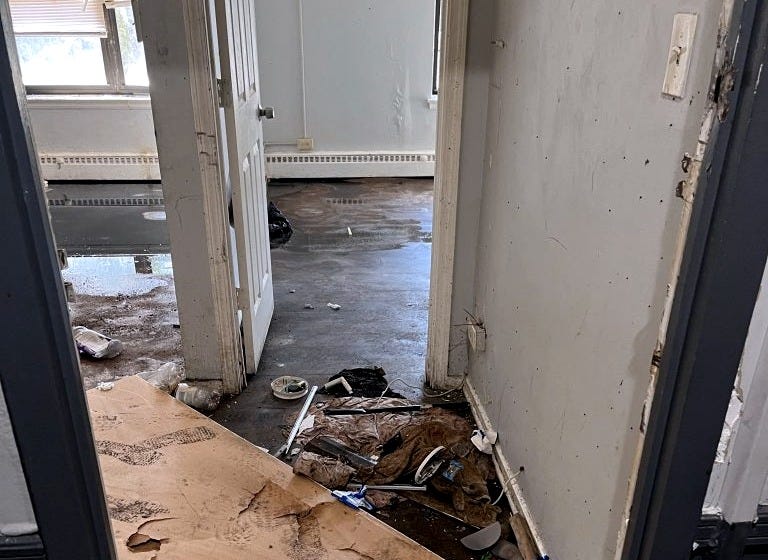
The moment ICE takes a person, everything they love is stranded in the wreckage. The government does not secure their belongings. No one bothers to notify a neighbor or a relative who could rush to help. The door is often left hanging wide open behind the agents, sometimes unable to close at all because the door handle was ripped off in the raid. Inside, the life that person built sits exposed to strangers, weather, and silence, waiting for someone who is not coming home.
Many of these pets end up in animal shelters. In Barstow, a man was taken during a Home Depot sweep and his dog — Chuco — wandered near his unattended car until a friend intervened and took the dog home until he could figure out where to take him. Sadly, the landlord dumped him at a shelter before he had the chance to figure it out.

A dog waits by it until the sun goes down, then curls up on a pile of clothes that still smell like the person who never comes back. A cat cries at the window until its voice gives out. Bowls sit empty. Water dries up. No one from the government stops to warn a neighbor or call a relative who would have run there in minutes.

In a system where ICE detains entire families at once, what happens when there is no one left to check in at all?
What happens when the good Samaritans who race to secure pets and homes after raids never hear a word because it happened in the dead of night? Or in some rural stretch of road where no one saw the lights?
Sometimes neighbors find out the next morning, when they notice a car idling in a driveway with the keys still inside. Or a lawnmower buzzing in circles in an empty yard. Or a stroller tipped over on a porch.
They look around for the person who should be there, but the only thing left is the absence. And by then the window to save anything is already closing.
Cars become the first casualties.ICE does not secure them, impound them, or notify anyone. They simply walk away. In Ontario, two landscapers were arrested mid job, leaving a lawnmower still running and their truck unlocked with phones and keys tossed inside.
In communities with heavy ICE activity, other opportunists may appear: there are reports of scavengers or thieves watching ICE raids and then swooping in to steal vehicles or valuables left at the scene. The FBI has even come out to warn the public that there are people pretending to be ICE agents to attempt to kidnap or rob individuals. And when agents are refusing to identify themselves, and wearing face masks, how do you know who is legitimate or not?

In one video, you can see an agent take a person’s car from the scene of the arrest. And in different video we can see another illegal seizure of someone’s car in Oregon. Something that is a direct violation of their own policies.
ICE is not allowed to just take your car when they detain you. Not unless the car is being seized under asset-forfeiture law, with a clearly documented criminal nexus. And 99 percent of ICE arrests do not meet that threshold. They can only do it if they can prove the car was used in a crime.
Almost none of their arrests meet that bar because immigration issues are civil, not criminal.
DHS’ own handbook says a car can only be taken if it was part of a crime, bought with money from a crime, or holds evidence of a crime.
Agents also have to get a warrant, fill out seizure paperwork, log the chain of custody, and move the car to an official evidence site. If those things don’t happen, taking the car breaks their own rules, and is felony theft.

In Eastvale, agents detained four people and abandoned their van in the middle of the street with the keys in the ignition until neighbors pushed it to safety.
Scenes like this now happen across Southern California. Cars idle until they die. Wallets and phones sit visible on seats. ICE leaves work trucks, vending carts, and equipment scattered in public spaces.
Tow companies usually get there first. Families who locate the car face storage fees they cannot pay, and the vehicle is lost. California alone has made more than eight million dollars from auctioning unclaimed cars since 2016, including over one million in 2023.
By the time relatives reach the tow yard, the car is already gone. Towed. Auctioned. Stripped. Another piece of a life turned into state revenue.
The homes are next.The moment a person is taken, the clock on their housing starts ticking. Rent goes unpaid because the one who paid it is gone. Calls go unanswered because no one is left to pick up. And landlords, especially in cities where ICE raids and evictions already run together, move fast.
Some states let landlords call a unit “abandoned” after seven days of silence. Delaware, Maine, New Hampshire, and Nebraska require only one week of storage before everything inside can be tossed or sold.
Other states give thirty or sixty days, but without a designated person or the money to intervene, that timeline becomes a countdown to erasure.
This is where a life begins to disappear.
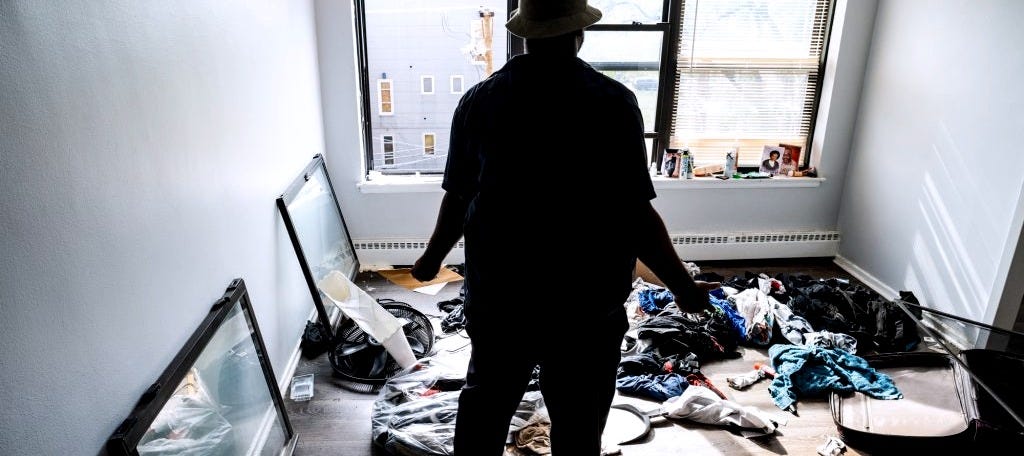
Family photos go first, then clothes, keepsakes, birthday cards, baby blankets, medical records, graduation certificates. Everything that proved a life was lived is treated as trash because it cannot be resold.
Sentimental value carries no weight in the eyes of the state or the property owner.
And this collapse does not only happen when whole families are detained.
It happens when one person goes missing, because ICE often arrests the breadwinner. You have documented this again and again. The father walking to work. The mother leaving a shift. The young adult supporting everyone at home.
ICE takes them, and suddenly the family inside that house cannot cover rent, food, utilities, or school supplies. They turn to GoFundMes asking strangers to help them survive the month. Without those donations, they lose everything. And not everyone gets a GoFundMe. I’ve shared many of those stories on this platform here.
Not everyone has a community that can mobilize overnight. Many families slip through the cracks quietly, invisibly.
In Oklahoma City, 20 agents raided the wrong home. And stole their entire life savings as “evidence” one family reported, and I can’t help but wonder how many other valuables are being stolen in the name of evidence?
Especially when ICE is known for using ruses to gain illegal entry into someone’s home because a civil warrant does NOT give them the right to enter your home.
ICE was even sued for stealing bond payments back in 2024 and got sued for it. Clearly this shows they are thieves, and always have been.

For some, the housing loss happens faster than anyone outside the family realizes. A single missed paycheck turns into two. The car sits unused. Eviction notices go unanswered. Landlords, especially the predatory ones, move quickly.
Chicago’s South Shore raid showed how low this can go. Ahead of the raid, certain unit doors were marked with white duct tape labeled “PC” or an “X” and others with duct tape that contained how many tenants. A map was even found outlining what homes were occupied by gun owners.
Information ICE would not have access to without an inside source.
ICE targeted the units marked “PC”.
After the raid, only about 35 out of 130 tenants remained. Many former tenants were Venezuelan asylum seekers caught in a web of foreclosure threats, dozens of eviction filings, and a landlord who had every financial incentive to clear the building. Whether coordinated or convenient, the raid cleared more bodies in one sweep than eviction court ever could.
And in states where landlords are legally allowed to keep or sell “abandoned” belongings to recover supposed losses, anything with value often disappears into their pockets.
Electronics. Jewelry. Cash in drawers. Tools. Items that could have helped a deported person rebuild their life in the country they were sent to. There is rarely anyone left who has the legal authority, time, or money to stop them.
If a family did want to fight for the home, they would need a lawyer. Most detained immigrants cannot afford one. Most families left behind cannot afford one.
So the home falls next. Not because it is unimportant, but because there is no structural value placed on protecting the people who lived there. And because the system ensures that when ICE takes one person, it can collapse the life of everyone connected to them.

This is how a single arrest becomes a total dispossession.
Dissent in Bloom 🌺 is a reader-supported publication. To receive new posts and support my work, consider becoming a free or paid subscriber.
The First Things Taken Are Phones, Wallets, and IDs and ICE Almost Never Returns ThemBefore a home is lost. Before a car is towed. Before a pet starves behind a locked door. The first things taken are always the things that prove who a person is. Phones. Wallets. Passports. Birth certificates. State IDs. Real IDs. All of it.
And for years, people have said the same thing: once ICE takes these documents, they rarely come back.
In 2023, ICE quietly rewrote its own identification-seizure policy. They framed it as a minor clarification, but it formalized a practice that had already been harming families for years.
The updated Policy 11311 instructs officers to confiscate any government-issued document a person has on them — foreign passports, state IDs, consular cards, birth certificates, Real IDs, driver’s licenses, work permits.

In exchange, ICE gives the person a “certified copy,” a stamped sheet of paper saying ICE now holds the original. The copy is often useless. It does nothing for someone who is transferred to another state, cut off from their belongings, or deported before ever seeing that paper again.
The policy also makes it clear that original IDs are not automatically returned. To get them back, a foreign government has to submit a written request. Not the person, not their family, and not their attorney. And even after that request, ICE only says it may return the documents. Bureaucratically, “may” almost always means no.
One line in the policy reveals the something: “identity documents should not be shredded if the detainee is also facing a criminal prosecution.”
Which tells you exactly what happens in the cases that aren’t tied to criminal court? These documents are shredded and thrown out like trash. So, why do they need to keep them? Just to make things more difficult?
There are countless real stories that show how devastating this is.A U.S. citizen in 2025 had his Real ID seized because ICE officers insisted it was “fake,” then tried to detain him anyway. This is concerning because real ID’s are supposed to almost equivocal to passports.
A Russian asylum-seeking couple in California had their passports taken during intake, and had to fight for their return after they were released.
Venezuelan families deported this year said officers confiscated their passports and simply kept them.
Children of immigrants had their school records and legal papers taken in 2022, triggering a lawsuit because some of those documents were the only proof that these kids even existed in government systems. But as we can see by their actions in 2025 this lawsuit changed nothing.
Many people deported to Guatamala this year had reported items disappearing. The items they did get back came in the form of a white sack, and not everything was there. Some people had no items at all.
None of this is random. Identification is survival. Identification is proof of personhood. When ICE takes it, the person becomes easier to detain, easier to deport, easier to disappear into a system designed to move faster than lawyers or families ever can. Try to imagine how difficult your life would be if you lost your ID today?
Without documents, people become whatever ICE writes on the form.
After deportation, they arrive in another country unable to access services, unable to reconnect with family, unable to legally return, unable to rebuild.
The first things taken are the things that anchor a person to the world. The things that say this is my name, this is my life, this is where I belong.
Dissent in Bloom 🌺 is a reader-supported publication. To receive new posts and support my work, consider becoming a free or paid subscriber.
How Did We Get Here?What we are seeing now is an intensification of a structure that has been quietly eroding people’s lives for years. To understand the brutality of the present moment, we have to look at the older policies and failures that made this escalation possible. And once this era ends, these systems will need to be dismantled from the foundation or the pattern will repeat itself
In 2016, the American Immigration Council found that forty one percent of migrants never got their belongings back. Phones vanished ninety two percent of the time. Cash disappeared nearly eighty percent. Voter IDs sixty four percent. In Ciudad Juárez almost seventy percent of deported people said nothing was returned. In Nogales it was forty five.
That same year, testimony before Congress made the situation plain. Migrants were being deported with no identification, no money, and no medication because their possessions were lost in the maze of CBP, US Marshals, ICE, and private detention centers. Everyone involved understood that belongings routinely vanished as immigrants were transferred between agencies over and over again.
That’s a practice that has amplified even more today. Detainees are transferred over, and over, and over. With the epi-center being in Louisiana where they’ve built a shadow detention network.
When the GAO (Government Accountability Office) investigated in 2024, their report simply confirmed what communities already knew in their bones. Border Patrol (CBP) had no consistent system at all. Agents were telling people to toss belongings because storage rooms were full or because an item looked “unsanitary.”
The standards were so vague that anything could be kept, lost, or destroyed with no recourse. It made no difference if the item was cash or a photograph tucked into a wallet or the only set of clothes someone owned. The system had been built without guardrails.
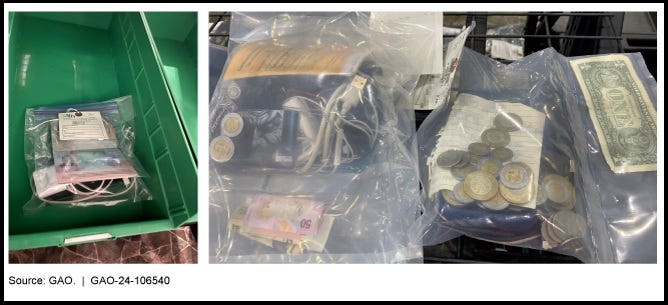
On paper it sounded good. Here’s what the directive actually says should be done:
It explicitly names “essential” Items: It names a wide range of items as “essential personal property” that cannot be stripped from migrants and must be safeguarded.
This includes legal and identity documents, medical items/medication, religious items, money, phones, and items of significant monetary or sentimental value.
But these people do not stay in CBP custody. They are transferred to ICE detention, and ICE has a policy in effect that states original identity documents will be kept. Another way they’ve found a ‘workaround’ here.
Property Custodians: It establishes “property custodians” at all CBP short-term holding facilities to oversee the property management programs, aiming for better accountability.
Written Instructions: It mandates that individuals be given written instructions on how to retrieve their stored belongings upon release. This recommendation came into effect because of the GAO report showing that the lack of communication was a major problem.
But like most things DHS does, it falls short, and is looks better on paper than it actually is. It’s vague enough and provides more than one work around for their typical DHS cruelty.